AI Assistants vs Human Helpers: Who Boosts Productivity More?
As AI innovations continue to redefine how we work, the debate between leveraging automated AI assistants or relying on human helpers grows more relevant. AI excels at automation and data analysis, while humans offer creativity and personalized support. Understanding their unique strengths helps businesses and individuals optimize productivity in a smarter tomorrow.
Introduction: Defining the Productivity Players
In the rapidly advancing realm of AI innovations and smart tech lifestyles, productivity enhancement has become a central focus. Two primary catalysts stand out: AI assistants—software agents powered by machine learning and natural language processing—and human helpers—colleagues, assistants, and consultants who bring empathy, nuance, and innovation to the table. This article compares these two distinct approaches, evaluating their impact on productivity across different contexts in 2026.
AI Assistants: Automation and Data Mastery
Modern AI assistants, including advanced agents developed by Anthropic and Google’s DeepMind, have transformed workflows by automating routine tasks such as scheduling, email management, and data processing. These assistants excel at handling large datasets rapidly, providing actionable insights through predictive analytics, and enabling real-time decision-making.
AI tools like Amazon’s AI agents automate customer service and sales workflows, freeing human workers to focus on higher-level tasks. According to McKinsey’s research, AI-driven automation can increase worker productivity by up to 40% in certain roles by reducing repetitive workload and accelerating information retrieval.
AI assistants’ strengths include 24/7 availability, consistency, rapid learning from new data, and scalability. They reduce errors in routine tasks and integrate seamlessly with smart devices, enhancing productivity for remote and hybrid work environments.
Human Helpers: Personalized Support and Creative Insight
While AI handles automation, human helpers bring irreplaceable qualities: empathy, ethical judgment, creativity, and contextual understanding. Complex problem-solving, nuanced communication, and innovation often require human intuition and emotional intelligence, which AI has yet to fully replicate.
Human colleagues provide tailored support, adapt dynamically to changing situations, and foster collaboration that sparks new ideas. In creative industries and leadership roles, human input remains crucial for strategic vision and motivational influence.
Research highlights that hybrid workflows, combining AI efficiency with human creativity, yield superior outcomes. As NeuralWaveJournal notes, integrating AI solutions alongside human expertise is becoming a best practice for maximizing productivity and innovation.
Pros and Cons: AI Assistants vs Human Helpers
| Aspect | AI Assistants | Human Helpers |
|---|---|---|
| Speed | High—instantaneous data processing and task execution | Moderate—dependent on individual capacity and workload |
| Accuracy | Consistent, reduces manual errors in routine tasks | Variable, prone to human error but adaptable |
| Creativity | Limited—based on training data and algorithms | High—innovative thinking and problem solving |
| Personalization | Improving with AI democratization but still generic | Highly personalized interactions and emotional intelligence |
| Cost Efficiency | Scalable and cost-effective for repetitive tasks | Higher cost due to salaries, training, and benefits |
| Scalability | Excellent—can be deployed broadly with minimal incremental cost | Limited by human resource availability |
| Adaptability | Fast in data-driven updates but limited in ambiguous contexts | Highly adaptable to complex and unforeseen scenarios |
Use Cases: When to Choose AI Assistants
AI assistants shine in environments with high volumes of repetitive or data-intensive tasks. Customer support centers benefit from AI chatbots that handle FAQs and basic issues, escalating complex inquiries to human agents. Project management tools powered by AI optimize scheduling and resource allocation efficiently.
For individuals, AI assistants help organize calendars, generate reports, and offer learning aids that boost daily productivity. The rise of Amazon Lex and similar platforms exemplifies how businesses streamline operations using intelligent automation.
Use Cases: When Human Helpers Are Indispensable
Human helpers remain essential for roles demanding creativity, emotional intelligence, and ethical considerations. Leadership, counseling, design, and strategic decision-making require human judgment that AI cannot yet replicate reliably.
In collaborative environments, human interaction fosters trust and motivation. Complex negotiations, conflict resolution, and mentorship are domains where human helpers uniquely boost productivity.
Hybrid Models: Maximizing Productivity Through Collaboration
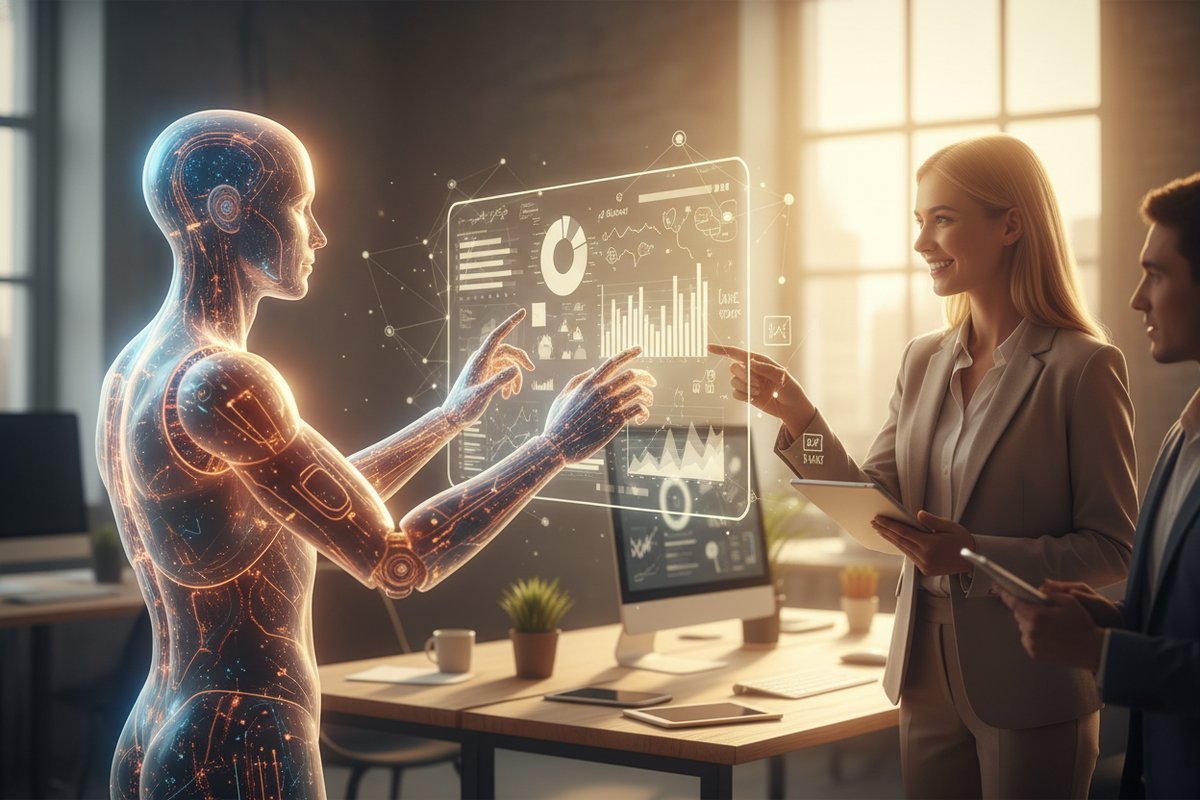
The future of productivity lies in hybrid workflows where AI assistants and human helpers complement each other. AI can handle data-heavy and routine tasks, providing humans with enhanced insights and more time to focus on creative and interpersonal work.
This synergy is evident in smart workplaces integrating AI tools like Google’s Gemini 3 Deep Think and Anthropic’s agentic AI with human teams, leading to improved efficiency and innovation. Companies adopting this hybrid model report higher employee satisfaction and better business outcomes.
Conclusion: Balancing Strengths for Smarter Productivity
AI assistants and human helpers each bring unique advantages to the productivity equation. AI excels in automation, consistency, and scalability, while humans provide creativity, personalization, and complex problem-solving capabilities. The optimal strategy in 2026 and beyond is a balanced integration that leverages AI’s strengths to augment human potential, creating smarter, more efficient workflows.
For businesses and individuals aiming to thrive in the evolving tech landscape, investing in AI solutions from leading innovators like Anthropic, Google DeepMind, and Amazon alongside human talent development offers the best path forward.